

By Obaida Karim, Nazia Islam, Subas Chandra Biswas, Ranjan Koiri
In rural Bangladesh, change is not always driven by high-level meetings or policy briefs. More often, it takes root in a community courtyard, under the open sky, where stories unfold through shared laughter, music, and open dialogue, creating opportunities for communities to reflect more clearly on their shared realities.
Art has long been a powerful medium for communicating ideas to the community in Bangladesh, not just to inform but to connect, engage, and empower. Among these, popular theatre holds a unique and powerful place. For decades, it has been used as a powerful tool for behavioural change communication, translating complex social issues into stories that people can see, feel, and relate to. Its strength lies in its widespread accessibility and affordability. It has strong ties to local communities’ reality, is performed in local languages, and invites widespread participation, and by doing so, it promotes introspection and inclusivity, creates spaces for community involvement, discussion, and group action, and fosters awareness and significant social change.
Under the SHINE Project, this long-standing tradition of popular theatre has been reimagined with a focused purpose: making the invisible community-related challenges and issues faced by community health workers (CHWs) visible. Interactive Popular Theatre (IPT) has been selected as part of a wider, holistic mental well-being intervention package to strengthen the health system by strengthening the mental well-being of CHWs.
To bring this approach to life, BRAC JPGSPH partnered with BRAC’s Social Empowerment and Legal Protection (SELP) Programme and CHWs to co-create a theatre performance based on the lived experiences of CHWs, stories that are often untold, unheard, or ignored, yet central to the mental well-being of the CHWs, aiming to sensitise the community.
Turning health system struggles into shared stories
The stories portrayed in the drama were not fictional but real-life stories of CHWs collected in the exploratory phase of the SHINE project, where they talked about different levels of day-to-day life challenges. These included challenges shaped not only by the health system, but also by community perceptions and expectations.
During subsequent intervention design workshops, the CHWs proposed popular theatre to address these issues. They selected some key stories that could dispel the misconception about their roles and improve the relationship with the communities they serve.
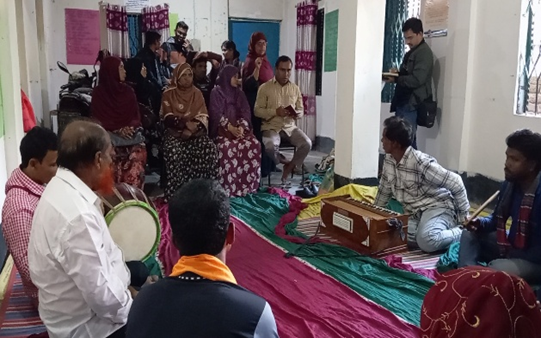
Based on these insights, the BRAC SELP’s script development team drafted the storyline in close consultation with the JPGSPH team, incorporating ongoing feedback throughout the process. A three-day-long field-based workshop was then organised with the local drama team, actors who belong to the very community, fluent in the local language, context, and culture. Together they refined the script, incorporated local folk elements, and rehearsed the drama.
During these workshops, CHWs were invited to observe the rehearsal and share their feedback and reflections to ensure authenticity and relevance. Their suggestions were carefully reviewed and integrated into the revised script. Subsequently, a premiere show was also organised, during which feedback was gathered from both community members and CHWs. This input was again incorporated, allowing further refinement before the main performances were rolled out.
The resulting dramas portrayed the challenges of three CHW cadres;
- Community Health Care Providers (CHCPs), who are often blamed for medicine shortages in the community clinics that are not within their control, and are being asked for excess medicines by influential people;
- Health Assistants (HAs), who carry heavy vaccine bags, while not having a fixed place for the Expanded Program on Immunisation (EPI), which ultimately makes them work in unfavourable conditions like open spaces, courtyards, or school corridors, etc., and with limited resources, such as without proper sitting arrangements; and
- Shasthya Kormis (SKs), who experience communities’ anger and confusion over the imposition of fees for ANC, PNC, or NCD services that were once used to be free.
When the audience recognises itself
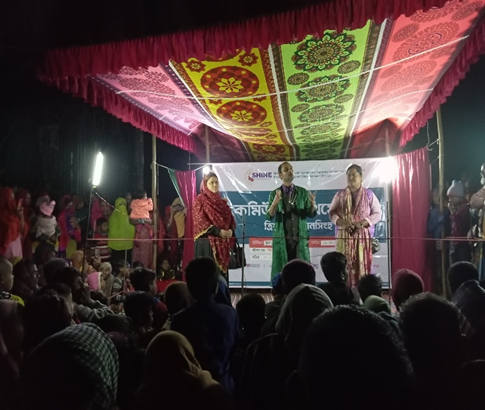
Between January and April 2026, a total of 40 performances, each followed by interactive quiz sessions, were held across 40 unions in five upazilas of Mymensingh and Barishal. Evening performances were scheduled to allow community members to attend after their daily work.
These performances went far beyond awareness-raising. They created spaces for conversation and collective reflection.
Gradually, blame gave way to understanding, as communities began to recognise the structural constraints and emotional pressures that shape the work of CHWs. Many audiences did more than simply enjoy the performance- they reflected based on their lived experiences. One participant pointed out, “CHCPs cannot sell medicines because these medicines are government-sealed”. Such moments mattered. They showed that people were not passively absorbing a message, but actively engaging with it. For many, the plays revealed realities they had never fully considered. “We did not know about many of these problems before”, one audience reflected.
Perhaps most striking was a comment from the mother-in-law of a CHW, who had come to watch the performance, who said quietly, “I never thought she (the CHW) had to go through all this”. Moments like this indicate a shift, from seeing CHWs as only service providers to recognising them as individuals working within systemic constraints.
Humour was an important factor. For example, “Jambu,” the typical rumour spreader and troublemaker, elicited laughter in the courtyard. However, there was a degree of recognition behind the laughter. “The people around us sometimes create problems for them,” a participant confessed.
There were differences in engagement among different age groups. Children were the most engaged in terms of laughter and filming scenes on their phones. The adolescents and young adults showed strong understanding of the core message in question-and-answer sessions and exit interviews. The older adults focused on practical messages and disease prevention. The diversity in engagement reflects the strength of theatre as a multi-layered communication tool.
Navigating resistance and adapting to context
However, the process was not always smooth. Despite prior coordination with the community gatekeepers, in some areas, the performances faced resistance, particularly around religious and cultural norms.
In certain communities, women were discouraged from sitting in the open courtyard alongside others. The use of traditional musical instruments, such as the dhol (traditional drum), was also questioned in a few places on religious grounds. In response, the popular theatre team adjusted quickly and negotiated with the community gatekeepers, adjusted formats, and ensured that performances remained culturally acceptable.
These instances of resistance are not failures. They are critical learning points. They serve as a reminder that community engagement, no matter how inclusive, has to be extremely attuned to the local context, beliefs, and power structures. For popular theatre to be truly inclusive, certain adaptations may be required, such as providing separate seating for women in some cases, or finding alternatives to musical instruments such as dhol that are acceptable to the local culture, and collaborating with local leaders and religious persons to sensitise the community.
Beyond awareness: Towards shared responsibility
As Bangladesh continues to strengthen its health system, tools like interactive popular theatre remind us of something essential: sustainable change depends not only on policies and resources, but also on relationships between communities and the frontline workers who serve them.
Interactive popular theatre demonstrates how complex health system challenges can be translated into shared narratives that foster empathy, dialogue, and collective responsibility. By making invisible struggles visible, it helps shift perceptions and build trust.
Sometimes, meaningful change begins not with a policy directive, but with a story, performed in a courtyard, witnessed by a community, and carried forward in how people think, relate, and act.
Acknowledgment
The authors would like to acknowledge the contribution of the CHWs, the community, the BRAC SELP team, and the JPGSPH team for the successful implementation of the popular theatre intervention.